
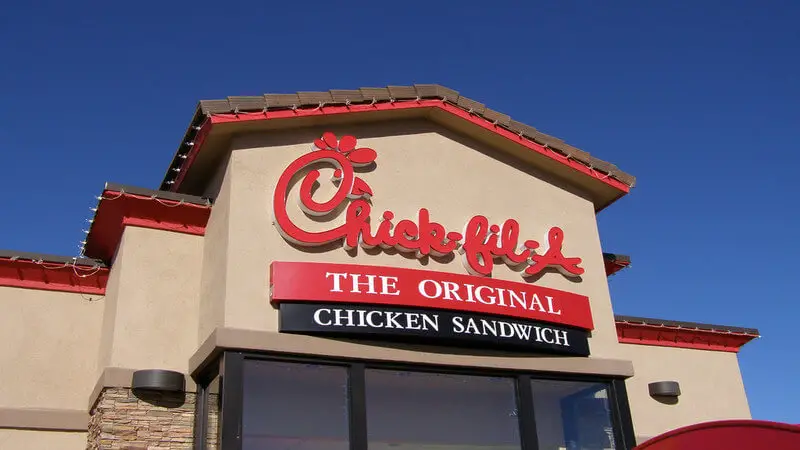
Chick-fil-A is not your typical fast-food chain. Founded by S. Truett Cathy in 1967 in Atlanta, Georgia, the privately held company has grown into a powerhouse with over 3,000 locations across the United States and Canada. Here is the part that should stop you in your tracks: Chick-fil-A generates the highest per-unit sales of any fast-food restaurant in America, and it does so while being closed every single Sunday. No public shareholders to answer to. No pressure to maximize operating hours. Just a relentless focus on chicken sandwiches, customer service, and a set of values that most Fortune 500 companies would never touch. Whether you admire Chick-fil-A or find its approach controversial, the results speak for themselves. Let’s break down the mission and vision statements that drive one of the most fascinating brands in American business.
Chick-fil-A Mission Statement
“To be America’s best quick-service restaurant at winning and keeping customers.”
This is a deceptively simple statement, and that is exactly what makes it effective. Chick-fil-A does not talk about “disrupting the industry” or “reimagining food experiences.” It says, plainly, that it wants to be the best at getting customers and holding onto them. Two verbs. Two jobs. Winning and keeping.
Notice the scope. The statement says “America’s best quick-service restaurant,” not “the world’s best.” As of 2026, Chick-fil-A has made only cautious moves into international markets. This is a company that knows exactly where its battlefield is and has no interest in overextending. Compare that to McDonald’s, which operates in over 100 countries and frames its mission globally. Chick-fil-A’s domestic focus is not a limitation. It is a strategic choice, and the per-unit revenue numbers prove it works.
The phrase “winning and keeping customers” also reveals a two-part operational philosophy. Winning customers means the food has to be excellent and the brand has to be attractive. Keeping customers means the experience has to be consistent, pleasant, and worth repeating. This is where Chick-fil-A’s famous “my pleasure” culture enters the picture. Every team member is trained to treat the drive-through like a sit-down dining experience. That is not an accident. It is a direct expression of the mission statement’s second verb: keeping.
The mission also implicitly explains Chick-fil-A’s limited menu strategy. The company has never tried to be everything to everyone. It does not chase every food trend or bolt on breakfast burritos and flatbreads to pad out the menu board. The chicken sandwich is the anchor, and everything else exists to support it. When your mission is to be the best at winning and keeping customers, you do not dilute attention across dozens of product lines. You perfect the thing people come for and make sure they never have a reason to stop coming back.
One more thing worth noting: the statement does not mention profit, revenue, or growth. For a company that reportedly crossed $21 billion in annual system-wide sales, that absence is telling. Chick-fil-A treats financial performance as an outcome of doing the mission well, not as the mission itself. That is a meaningful philosophical difference from most competitors in the quick-service space.
Chick-fil-A Vision Statement
“To glorify God by being a faithful steward of all that is entrusted to us and to have a positive influence on all who come in contact with Chick-fil-A.”
Chick-fil-A officially calls this its “corporate purpose,” but it functions as the company’s vision statement. And it is, without question, one of the most unusual guiding statements in American corporate life. No publicly traded company of this scale would publish these words. Chick-fil-A can, because it is privately held and has never had to answer to Wall Street analysts who would squirm at the word “God” on an earnings call.
The statement has two halves, and both matter. The first half, “to glorify God by being a faithful steward of all that is entrusted to us,” establishes a faith-based framework for how the company approaches its resources, people, and opportunities. Stewardship is the key concept here. Chick-fil-A does not view itself as an owner of its assets but as a caretaker. That philosophy shows up everywhere, from how the company selects and develops its restaurant operators to how it reinvests profits into employee scholarships and community programs.
The second half, “to have a positive influence on all who come in contact with Chick-fil-A,” is broader and more outward-facing. This is the part of the corporate purpose that translates most directly into daily operations. It is why Chick-fil-A operators are expected to be deeply embedded in their local communities. It is why the company’s training programs emphasize character development alongside operational skills. And it is why the restaurant experience feels different from grabbing a bag at most other drive-throughs.
The Sunday closure policy is the most visible expression of this corporate purpose. S. Truett Cathy established the practice when he opened his first restaurant, and the company has maintained it through every phase of growth. In a pure business sense, closing one day a week means forfeiting roughly 14 percent of potential revenue. For a chain generating the kind of per-unit sales Chick-fil-A produces, that is an enormous number in absolute dollars. But the policy reinforces the stewardship concept. It communicates to employees and operators that people are more important than transactions. And from a brand standpoint, it creates scarcity. There is a reason the drive-through lines are so long on Saturdays.
Of course, this corporate purpose has also been the source of significant controversy. Chick-fil-A’s faith-based identity and past donations to organizations opposed to same-sex marriage drew intense criticism and boycott campaigns. The company has since shifted some of its philanthropic focus, but the corporate purpose remains unchanged. This is a tension the brand lives with, and it has not shown signs of backing away from the foundational statement regardless of public pressure.
Compared to the vision statements of competitors like Starbucks, which frames its purpose around “nurturing the human spirit,” Chick-fil-A’s corporate purpose is more explicitly anchored in a specific belief system. Whether that is a strength or a vulnerability depends on your perspective, but there is no denying its clarity. Everyone inside and outside the company knows exactly what Chick-fil-A stands for.
Analysis of Chick-fil-A’s Mission and Vision
Strengths
The most obvious strength of Chick-fil-A’s guiding statements is their authenticity. These are not words crafted by a branding agency to sound good on a website. They reflect the actual, observable behavior of the company at every level. When a mission statement says “winning and keeping customers” and the company simultaneously leads the industry in customer satisfaction scores, drive-through speed, and per-unit sales, the statement is doing its job. Too many companies write aspirational mission statements that have zero connection to daily reality. Chick-fil-A is not one of them.
The operator model reinforces both statements powerfully. Unlike traditional franchise systems where anyone with enough capital can buy a location, Chick-fil-A selects operators through a rigorous process that accepts fewer than 1 percent of applicants. Operators do not own their restaurants. They run them. Chick-fil-A covers the startup costs and retains ownership of the real estate and equipment. In return, operators commit to being hands-on, present, and personally accountable for the customer experience. This model is a direct structural expression of the stewardship language in the corporate purpose. It also ensures that the “winning and keeping customers” mission is executed by people who are deeply invested in their individual locations rather than by absentee owners managing a portfolio.
Another strength is the clarity of scope. Chick-fil-A is not trying to do everything. The mission focuses on quick-service restaurants in America. The menu focuses on chicken. The operating model focuses on single-operator accountability. This kind of intentional constraint is rare in an industry that constantly pushes for expansion, diversification, and global footprint. By staying narrow, Chick-fil-A maintains a level of execution quality that broader competitors struggle to match. Compare the consistency of a Chick-fil-A experience across locations to the wildly variable quality you might encounter at a McDonald’s in different cities. The focus makes a difference.
The emotional connection Chick-fil-A builds with its customer base is another notable strength. The corporate purpose gives employees and operators a sense of meaning that goes beyond selling sandwiches. People who work at Chick-fil-A frequently describe the culture as distinct from other fast-food environments. That culture translates directly into the customer experience, which translates directly into loyalty, which translates directly into the financial results. The mission and vision create a self-reinforcing loop.
Weaknesses
The most significant weakness is the inherent exclusivity of the corporate purpose. By anchoring its vision in a specific religious tradition, Chick-fil-A draws a line that makes some customers, employees, and communities uncomfortable. The boycotts and controversies of the past decade are not going away. In a business environment that increasingly values inclusive language and secular corporate identity, a statement that begins with “to glorify God” is a polarizing choice. This does not appear to have hurt Chick-fil-A’s bottom line so far, but it limits the brand’s ability to expand into certain markets and demographics without friction.
The domestic focus of the mission statement is both a strength and a constraint. As of 2026, Chick-fil-A has begun testing international markets, but the mission statement still says “America’s best.” If the company is serious about global growth, the mission will need to evolve, or the company will be operating outside the boundaries of its own stated purpose. That kind of misalignment between words and actions erodes the very authenticity that makes the statements effective in the first place.
There is also a transparency issue. The corporate purpose talks about having “a positive influence on all who come in contact with Chick-fil-A,” but the company has historically been selective about what that influence looks like and who defines “positive.” The philanthropic controversies highlighted a gap between how Chick-fil-A sees its influence and how parts of the public perceive it. A vision statement that claims universal positive impact sets a very high bar, and any instance where the company falls short of that bar becomes amplified precisely because the statement is so bold.
Finally, the mission statement’s focus on “quick-service restaurant” could become limiting as the food industry evolves. The line between quick-service, fast-casual, and delivery-first concepts is blurring. Chick-fil-A has already moved into catering, delivery partnerships, and digital ordering in ways that stretch the traditional definition of quick-service. The mission may need updating to reflect the broader ways customers interact with the brand in 2026 and beyond.
Taken together, Chick-fil-A’s mission and corporate purpose form one of the most distinctive and internally consistent strategic identities in American business. The company’s willingness to put faith, restraint, and customer obsession at the center of its identity, and then actually operate that way every single day, is what separates it from competitors who treat mission statements as wall art. Whether the approach can sustain itself through international expansion, cultural shifts, and an evolving competitive landscape is the open question. But as of now, the results make the case better than any corporate statement ever could.