
GCU Mission Statement Analysis (2026)
Grand Canyon University occupies one of the most unusual positions in American higher education. Founded in 1949 as a small Baptist college in Phoenix, Arizona, GCU has transformed itself into one of the largest universities in the United States, enrolling over 100,000 students across its ground campus and online programs. Its journey from a struggling nonprofit institution to a for-profit powerhouse under Grand Canyon Education, Inc., and then back to nonprofit status, represents a case study in institutional reinvention that few universities can match.
That transformation makes GCU’s mission and vision statements particularly worth examining. These are not static declarations drafted decades ago and left untouched. They are living documents shaped by an institution that has fundamentally redefined what it is, who it serves, and how it operates — multiple times within a single generation. Understanding what GCU says about itself, and where those statements succeed or fall short, requires understanding the institution’s extraordinary and sometimes controversial trajectory.
For readers unfamiliar with the distinctions between these two types of organizational declarations, a helpful primer is available in our guide on the difference between mission and vision statements.
GCU Mission Statement
Grand Canyon University’s mission statement reads:
“Grand Canyon University prepares learners to become global citizens, critical thinkers, effective communicators and responsible leaders by providing an academically challenging, values-based curriculum from the context of our Christian heritage.”
This is a carefully constructed statement that attempts to balance several competing demands: the expectations of secular accrediting bodies, the identity commitments of a Christian university, the pragmatic needs of a massive enrollment operation, and the aspirational goals that prospective students and their families want to hear. It is, in many respects, a diplomatic achievement. Whether it is an honest one is a separate question.
Strengths of GCU’s Mission Statement
Outcome-oriented language. The mission statement leads with action. “Prepares learners to become” is a functional, measurable framing that positions the university as a vehicle for transformation rather than a passive repository of knowledge. This is a meaningful distinction. Many university mission statements describe what the institution is rather than what it does, which makes them difficult to evaluate. GCU’s statement, by contrast, establishes clear categories of intended outcomes: global citizenship, critical thinking, effective communication, and responsible leadership. Each of these can, at least in theory, be assessed.
The word “learners” instead of “students.” This is a subtle but deliberate choice. “Students” implies a traditional relationship between institution and individual — enrollment, attendance, graduation. “Learners” is broader. It accommodates the online adult learner completing a degree while working full-time, the military veteran accessing education through GI Bill benefits, and the working professional pursuing a graduate certificate. Given that the vast majority of GCU’s enrollment consists of online students who do not fit the traditional undergraduate profile, this word choice reflects operational reality rather than aspirational fiction.
The “context of our Christian heritage” framing. This phrase performs a delicate balancing act. It affirms GCU’s Christian identity without making doctrinal adherence a prerequisite for enrollment or participation. The word “context” is doing significant work here — it positions Christianity as a framework within which education occurs, not a filter through which all content must pass. This allows GCU to maintain its identity as a Christian university while offering programs in fields like nursing, business, and information technology where overtly religious content would be inappropriate or counterproductive. Compare this to institutions like Liberty University, which foreground doctrinal commitments more aggressively, or to Loma Linda University, which integrates its Seventh-day Adventist identity into a health sciences mission with considerably more specificity.
Concision. At 34 words, the statement is compact enough to be memorable and reproducible. It fits on a business card. It can be recited at orientation. In a sector where mission statements routinely sprawl across multiple paragraphs and include laundry lists of stakeholder commitments, GCU’s brevity is a genuine asset.
Weaknesses of GCU’s Mission Statement
Generic outcome categories. “Global citizens, critical thinkers, effective communicators and responsible leaders” is a sequence that could appear in the mission statement of virtually any university in the country. These are consensus virtues — no institution would claim to produce parochial, uncritical, inarticulate, irresponsible graduates. The statement tells us what GCU shares with every other university, not what distinguishes it from them. A prospective student reading this statement would learn nothing about GCU that could not be said, with equal plausibility, about Arizona State University, the University of Phoenix, or Wheaton College.
No mention of accessibility or affordability. GCU has built its brand, and its enrollment numbers, on the promise of making higher education accessible to populations underserved by traditional institutions: working adults, first-generation college students, military-connected learners, and those in underserved geographic regions. This is arguably GCU’s most distinctive contribution to the higher education landscape. Yet the mission statement contains no reference to access, affordability, flexibility, or any of the characteristics that actually drive enrollment decisions for the majority of its student body. The statement describes a traditional liberal arts aspiration while the institution operates as something fundamentally different.
The “values-based curriculum” is undefined. What values? Whose values? “Values-based” is a phrase that sounds substantive but communicates almost nothing. It could refer to Christian ethical principles, professional ethics in specific disciplines, civic virtues, or simply the vague notion that education should involve moral formation. Without specificity, the phrase functions as a placeholder — a signal to religiously oriented families that GCU is “safe” without committing to any particular moral or theological framework that might alienate other market segments.
Absence of the online modality. The overwhelming majority of GCU’s students — roughly 80 percent or more — are enrolled in online programs. This is the defining operational reality of the institution. A mission statement that fails to acknowledge, let alone address, the primary mode of educational delivery is a statement that describes a different university than the one that actually exists. It is as though an airline’s mission statement discussed the joy of travel without mentioning airplanes.
GCU Vision Statement
GCU’s vision statement reads:
“Grand Canyon University is a premier Christian university educating people to lead and serve.”
At 14 words, this is among the most concise vision statements in higher education. Its brevity forces a concentrated examination: every word must justify its inclusion, because there is nowhere for weak language to hide.
Strengths of GCU’s Vision Statement
The aspirational claim of “premier.” A vision statement should describe a desired future state, and “premier” does that work efficiently. GCU is not claiming to be the best university in America. It is claiming to be — or aspiring to be — the best Christian university. This is a narrower and more defensible aspiration. It positions GCU’s competitive set not against the Ivy League or the major state research universities but against institutions like Baylor, Pepperdine, and Liberty. Whether GCU can credibly claim premier status in that category is debatable, but the aspiration itself is strategically sound.
“Lead and serve” as complementary imperatives. This pairing reflects a genuinely Christian philosophical framework — the idea that authentic leadership is expressed through service, drawn from the theological concept of servant leadership rooted in the Gospel accounts. It is one of the few places in GCU’s public-facing language where the Christian identity feels substantive rather than decorative. The conjunction “and” is important: GCU is not asking students to choose between leading and serving but presenting them as inseparable dimensions of the same vocation.
Present tense construction. “Grand Canyon University is a premier Christian university” uses the present tense, which is an assertive rhetorical choice for a vision statement. Rather than saying “we aspire to become” or “we strive to be,” GCU declares itself already in possession of the status it seeks. This is either confidence or presumption, depending on one’s assessment of the institution, but as a piece of strategic communication, it is effective.
Weaknesses of GCU’s Vision Statement
The “premier” claim lacks substantiation. By what measure is GCU a premier Christian university? Not by research output, where it trails institutions like Baylor and Notre Dame by enormous margins. Not by selectivity, where its acceptance rate of approximately 80 percent places it firmly in the open-access category. Not by endowment, faculty credentials, or alumni achievement in the traditional metrics that define institutional prestige. GCU’s claim to premier status rests almost entirely on scale — it is one of the largest Christian universities — and on the quality of its ground campus experience in Phoenix. Scale is an achievement, but “premier” implies qualitative distinction, not quantitative dominance.
No forward-looking dimension. The present-tense construction that functions as a strength in one reading becomes a weakness in another. A vision statement should articulate where an institution is going, not merely assert where it already is. By declaring itself already “premier,” GCU eliminates the aspirational tension that gives a vision statement its motivating power. What is the university working toward? What does the next decade look like? The statement provides no trajectory, no ambition beyond the status quo. Compare this to the vision statements of institutions like the University of Southern California, which articulate specific dimensions of future impact and growth.
Vagueness of “people.” “Educating people to lead and serve” offers no indication of which people, in what fields, toward what ends. The word “people” is maximally inclusive and minimally informative. It tells us nothing about GCU’s understanding of its student population, its priority disciplines, or the communities it intends to serve. A vision statement need not be a strategic plan, but it should offer some indication of institutional direction beyond a generic commitment to education.
The For-Profit to Nonprofit Transition
No analysis of GCU’s institutional identity can ignore the elephant in the room: its complex corporate structure and the prolonged, contested transition from for-profit to nonprofit status. Understanding this history is essential to evaluating the authenticity of the mission and vision statements.
In 2004, facing severe financial distress, the then-nonprofit GCU was acquired by investors and converted to a for-profit institution. In 2008, the university went public through Grand Canyon Education, Inc. (LOPE), which was listed on the NASDAQ. Under the leadership of Brian Mueller, who served as CEO, GCU experienced explosive growth, transforming from a small regional college into a national institution with enrollment exceeding 100,000.
In 2018, GCU announced that it had reacquired its academic operations from Grand Canyon Education, Inc., and had been granted nonprofit status by the IRS. However, the structure of this separation raised immediate concerns. Grand Canyon Education, Inc. — the publicly traded, for-profit company — continued to provide virtually all operational services to the “nonprofit” university under a long-term master services agreement. GCU paid GCE approximately 60 percent of its revenue for these services. Brian Mueller continued to serve in leadership roles at both entities.
The Higher Learning Commission (HLC), GCU’s regional accreditor, initially approved the conversion but subsequently raised concerns. The Department of Education imposed a fine of $37.7 million on GCU in 2023 — one of the largest penalties ever levied against a university — for misleading students about the cost of its doctoral programs. The HLC placed GCU on probation, and the institution’s nonprofit status became the subject of sustained scrutiny from regulators, journalists, and higher education policy analysts.
This history matters for the mission and vision analysis because it raises a fundamental question: when GCU describes itself as a Christian university dedicated to preparing global citizens and responsible leaders, is that statement the authentic expression of an educational institution’s purpose, or is it the marketing language of what remains, in functional terms, a revenue-generating operation for a publicly traded company? The mission statement’s silence on issues of corporate governance, financial transparency, and institutional independence is, in this context, a conspicuous omission.
The Online Education Model
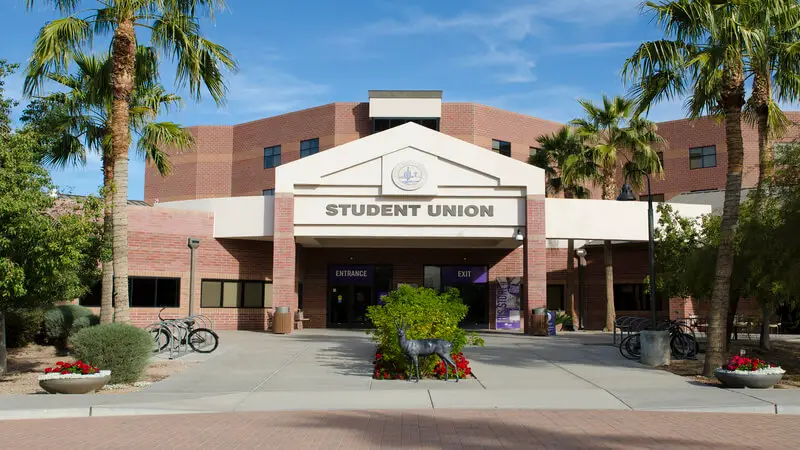
GCU operates what amounts to two distinct universities under a single name. The ground campus in Phoenix is a traditional residential experience — a 275-acre campus with dormitories, athletics (GCU competes in NCAA Division I), student organizations, and the physical infrastructure of conventional university life. This campus enrolls roughly 25,000 students and is, by most accounts, a competent if not distinguished regional university.
The online operation is something else entirely. With approximately 80,000 to 90,000 students enrolled in online programs, GCU’s digital campus dwarfs its physical one. These students are overwhelmingly adults, many of them working full-time, pursuing degrees in high-demand professional fields: nursing, education, business administration, counseling, and information technology. The online programs are delivered through a standardized curriculum with structured schedules, designed for scalability rather than customization.
The mission statement’s promise to create “global citizens, critical thinkers, effective communicators and responsible leaders” through a “values-based curriculum” must be evaluated against this operational reality. Online education at scale presents inherent challenges to the kinds of outcomes the mission statement describes. Critical thinking, in most pedagogical frameworks, is developed through sustained dialogue, Socratic questioning, and iterative engagement with complex problems — activities that are difficult, though not impossible, to replicate in an asynchronous online environment with large class sizes and adjunct-heavy faculty models.
This is not to say that online education cannot be rigorous or transformative. It can. But when an institution’s mission statement reads as though it describes a residential liberal arts experience while the institution primarily delivers something quite different, the gap between rhetoric and reality deserves scrutiny. The mission statement would be stronger if it acknowledged the online modality and articulated specific commitments to quality within that context.
Christian University Identity
GCU’s Christian identity occupies an interesting middle ground in the landscape of faith-based higher education. It is not a Bible college. It does not require students to sign doctrinal statements or behavioral covenants of the kind found at institutions like Cedarville University or Bob Jones University. It does not restrict faculty hiring to members of a particular denomination, though it does expect faculty to be supportive of the university’s Christian mission. Its roots are Baptist, but its current denominational affiliation is interdenominational in practice.
This positioning is strategically advantageous. It allows GCU to market itself to Christian families who want a faith-friendly environment without the rigidity of a confessional institution. It simultaneously allows the university to recruit non-Christian students — particularly in its online programs — who are drawn by program availability, scheduling flexibility, or tuition pricing rather than religious affiliation. The mission statement’s phrase “from the context of our Christian heritage” is the textual embodiment of this strategy: Christian enough to claim the identity, flexible enough not to be constrained by it.
The question is whether this middle ground represents authentic institutional identity or market positioning. There is a version of this analysis in which GCU is a thoughtful, inclusive Christian university that takes its faith tradition seriously while welcoming all comers. There is another version in which the Christian identity is a brand differentiator that generates enrollment from a specific demographic without imposing the costs — curricular, cultural, or financial — that a deeper religious commitment would entail. The mission and vision statements do not resolve this ambiguity. They perpetuate it.
Among Christian institutions, it is instructive to compare GCU’s approach to that of Loma Linda University, which integrates its faith identity into a highly specific health sciences mission with demonstrable outcomes in underserved communities. Loma Linda’s mission feels inseparable from its operations. GCU’s mission feels more like a layer applied on top of operations that would function similarly without it.
Growth Strategy and Its Implications
GCU’s growth trajectory over the past fifteen years has been extraordinary by any measure. From fewer than 1,000 ground students and a handful of online programs in 2008, the university has grown to a combined enrollment exceeding 100,000. The Phoenix campus has been transformed through billions of dollars in capital investment — new academic buildings, residence halls, athletic facilities, a hotel and conference center, and a comprehensive campus infrastructure that rivals many state universities.
This growth has been driven by several factors: aggressive marketing (GCU’s advertising budget is substantial), competitive tuition pricing relative to other private universities, the expansion of online program offerings, and strategic investments in the ground campus experience. The university has also benefited from its location in one of America’s fastest-growing metropolitan areas and from the broader cultural shift toward online education that accelerated dramatically during and after the COVID-19 pandemic.
The mission and vision statements should be read in the context of this growth strategy. When the vision statement declares GCU “a premier Christian university,” it is asserting a status that growth has, in its own terms, created. GCU is undeniably one of the most prominent Christian universities in America — not because of academic distinction in the traditional sense, but because of sheer scale, brand recognition, and market presence. This is a different definition of “premier” than most academics would use, but it is not an entirely illegitimate one.
However, growth at this scale creates tensions with the mission statement’s emphasis on preparing “critical thinkers” and “responsible leaders.” Rapid enrollment growth in online programs typically requires standardized curricula, large section sizes, and heavy reliance on adjunct faculty — conditions that do not naturally foster the kind of individualized intellectual development that critical thinking requires. The mission statement promises artisanal outcomes from an industrial process, and that tension has never been fully resolved in GCU’s public messaging.
Criticism and Accreditation Challenges
GCU has faced sustained criticism from multiple directions, and these criticisms bear directly on the credibility of its mission and vision statements.
The Department of Education fine. In 2023, the Department of Education fined GCU $37.7 million for deceiving prospective doctoral students about program costs. The department found that GCU had understated the total cost of its doctoral programs by thousands of dollars, leading students to take on more debt than they had been told to expect. For an institution whose mission statement emphasizes “responsible” leadership and whose operations depend on the trust of students making significant financial decisions, this finding was damaging. A mission that promises responsible leadership while the institution engages in irresponsible disclosure represents a credibility gap that no amount of careful wording can bridge. GCU contested the fine and its characterization of the facts, but the regulatory finding remains part of the institution’s record.
HLC probation. The Higher Learning Commission’s decision to place GCU on probation was a serious accreditation action that reflected concerns about institutional governance, financial transparency, and the relationship between GCU and Grand Canyon Education, Inc. Probation does not mean loss of accreditation, but it signals that the accreditor has identified significant issues requiring remediation. For an institution claiming “premier” status, probationary accreditation is a significant contradiction.
The nonprofit question. Multiple analyses — from journalists, higher education researchers, and government investigators — have questioned whether GCU’s conversion to nonprofit status was substantive or cosmetic. The continued flow of approximately 60 percent of university revenue to the for-profit Grand Canyon Education, Inc. under the master services agreement has been characterized by critics as a structure that preserves the economics of for-profit higher education while claiming the tax benefits and reputational advantages of nonprofit status. If this characterization is accurate, then the mission and vision statements are not merely aspirational documents; they are elements of a branding strategy designed to obscure the institution’s true financial structure.
Student outcomes. GCU’s graduation rates, while improved in recent years for ground campus students, remain a concern for online students. Loan default rates and debt-to-income ratios for graduates of certain programs have drawn scrutiny. For a mission statement built around preparing learners to become effective professionals, student outcomes data is the most direct test of institutional integrity. The results are mixed at best.
It is worth noting that many of these criticisms apply broadly to the large-scale online higher education sector, not exclusively to GCU. Institutions like the University of Phoenix, Strayer University, and others have faced similar scrutiny. But GCU’s claims to Christian identity and premier status invite a higher standard of evaluation. When an institution explicitly grounds its mission in moral and ethical values, it invites judgment against those values.
Final Assessment
Grand Canyon University’s mission and vision statements are competently crafted pieces of institutional communication. They are concise, grammatically clean, and strategically positioned to appeal to a broad audience without alienating any significant constituency. They do what most university mission statements do: they describe a version of the institution that is recognizable but idealized, emphasizing universal virtues while eliding operational complexities.
The mission statement’s strengths are real. Its outcome-oriented language, its inclusive terminology, and its careful positioning of Christian identity within an accessible framework all reflect thoughtful drafting. These are not accidental word choices; they are the product of an institution that understands its market position and its rhetorical needs.
But the weaknesses are equally real, and they are more consequential. The mission statement describes a university that does not quite exist — a residential learning community focused on holistic human development, when the actual institution is primarily a large-scale online education provider with a beautiful campus attached. The vision statement claims premier status that the institution’s academic profile, accreditation history, and regulatory record do not support. Both statements avoid engaging with the defining features of GCU’s actual operations: its scale, its online modality, its corporate structure, and its commercial orientation.
The gap between GCU’s stated mission and its operational reality is not unique. Many universities, including prestigious ones, maintain mission statements that bear only a passing resemblance to daily institutional life. The difference with GCU is the magnitude of the gap and the stakes involved. When a university enrolls over 100,000 students, many of them from economically vulnerable populations making significant financial commitments, the accuracy and honesty of its self-representation is not merely an academic exercise. It is a matter of consumer protection, institutional ethics, and educational integrity.
GCU’s mission and vision statements would benefit from revision that acknowledges what the institution actually is: a large-scale, technology-enabled university with a Christian identity that provides accessible professional education to working adults and traditional students alike. That is not a lesser mission than the one currently stated. In many respects, it is a more important and more honest one. The best mission statements in higher education, and in other sectors as documented in our analysis of leading organizations’ mission and vision statements, are those that describe the institution as it is and articulate where it intends to go — without pretending to be something it is not.
Until GCU reconciles its public-facing statements with its operational realities, its mission and vision will function less as authentic declarations of purpose and more as marketing copy — well-written, carefully targeted, and fundamentally incomplete.